
The trajectory of artificial intelligence has reached a pivotal inflection point, shifting away from the relentless pursuit of larger models toward a more nuanced understanding of efficiency and adaptability. Recent synthesis reveals that the next frontier is not defined by raw computational power alone, but by the strategic integration of frozen pretrained priors and cross-embodiment transfer. A striking example of this paradigm shift is found in the RepFusion framework, which demonstrates that leveraging existing semantic knowledge yields a 30% relative gain in text-to-image generation compared to training new denoisers from scratch. This specific metric underscores a fundamental realization: the future of AI lies not in building anew, but in intelligently repurposing what already exists to solve complex, real-world problems with greater efficiency.
The current research landscape is characterized by a move toward integrated, persistent systems that bridge the gaps between isolated modalities. Traditionally, advancements in vision, language, and action have proceeded in silos, yet today's findings highlight the power of unifying these domains. The Hy-Embodied-0.5-VLA study exemplifies this by enabling the transfer of policies trained on human data to morphologically distinct robots without requiring target-specific teleoperation. This capability suggests that the barriers between different physical forms are becoming porous, allowing intelligence to flow seamlessly from biological agents to mechanical ones. Similarly, the Orchestra-o1 framework achieves a 32.8% improvement over baseline models by unifying modality-aware task decomposition, proving that synchronized execution across text, image, and audio yields superior reasoning capabilities. These developments indicate that the field is maturing from a collection of disjointed tools into a cohesive ecosystem capable of handling multi-dimensional challenges.
A critical theme emerging from this body of work is the tension between static evaluation and dynamic state retention. While earlier benchmarks focused heavily on visual fidelity or immediate accuracy, new research exposes deeper systemic limitations. MBench, the first comprehensive benchmark for video world model memory, reveals that state-of-the-art models often suffer from "amnesia," failing to retain functional state stability over time despite maintaining high visual quality. This finding challenges the assumption that high-resolution output equates to robust understanding. Complementing this, Avatar V addresses the loss of dynamic traits in generation by conditioning models on full reference video sequences rather than static images, utilizing Sparse Reference Attention to achieve linear-complexity conditioning. Together, these studies argue that true intelligence requires not just recognizing a moment, but maintaining the continuity of identity and context across time.
Furthermore, the efficiency of hybrid modalities is reshaping how agents interact with information. The integration of visual structural context alongside text interfaces, as seen in studies on LLM agents viewing code repositories, reduces input token consumption by up to 26% while maintaining accuracy. This quantifiable reduction in computational overhead validates the hypothesis that combining modalities creates a more efficient pathway for autonomous navigation. In the realm of communication, the See What I See, Know What I Think framework achieves 2–3× lower compute costs through a unified KV-cache mechanism, solving the challenge of latent alignment across heterogeneous agents. These metrics collectively demonstrate that the path forward involves optimizing the interface between different forms of knowledge, rather simply increasing the scale of individual models.
The State of Play

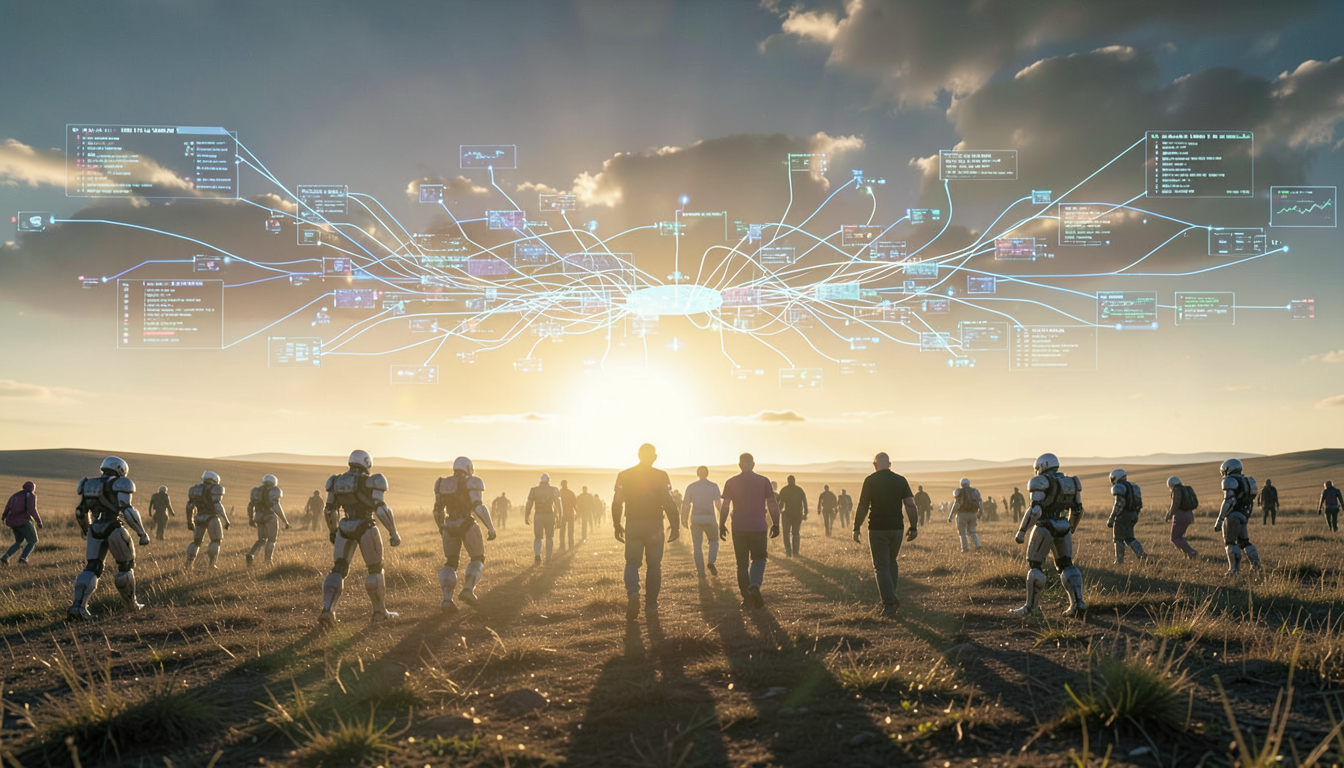
The field currently stands at a threshold of persistent autonomy, transitioning from reactive "chatbot" interfaces to proactive "Digital Colleagues." Researchers are no satisfied with systems that merely generate answers; the demand has shifted toward agents that maintain context, adapt to new environments, and collaborate across modalities. The dominance of frozen pretrained models in recent literature confirms that the community values the efficiency of leveraging established priors over the cost of training from scratch. Simultaneously, the focus on cross-embodiment transfer indicates a growing confidence in the portability of intelligence, suggesting that policies learned in one domain can robustly apply to others. This maturation marks a departure from isolated benchmarking toward the development of reliable, state-aware systems capable of operating within the complex dynamics of the real world.
Three Questions That Need Answers
- Does the constraint of "model-internalized priors" identified in annotation tasks impose a hard limit on adaptability in creative domains like code synthesis or artistic generation?
- Can the 30% relative gain observed in repurposing frozen priors for text-to-image generation be replicated in non-semantic latent spaces where no existing prior knowledge exists?
- Is the cross-embodiment transfer of policies robust enough to scale from human data to extreme morphological differences, suchsoft robots versus rigid manipulators, without significant performance degradation?
KHI Research Editorial Team
Published by KHI Research · 2026-06-15 · AI Methodology
Discussion