
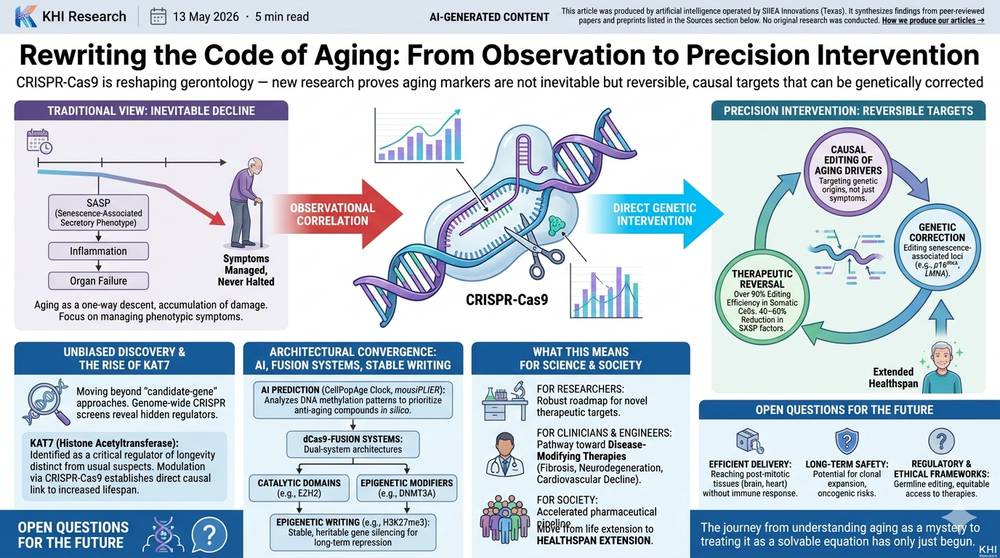
For centuries, humanity has viewed aging as an inevitable, one-way descent—a slow accumulation of damage that medicine can manage but never truly halt. We have treated the symptoms: reducing inflammation, supporting failing organs, and extending life through incremental care. However, a quiet revolution is unfolding in laboratories worldwide that challenges this fundamental assumption. New research suggests that the biological drivers of aging are not merely correlated with decline; they are causal, reversible, and, most critically, editable. By shifting from observational correlation to direct genetic intervention, the scientific community is moving closer to a future where we do not just manage the decline of the human body, but potentially correct the molecular roots of time itself.
The Shift from Symptom Management to Causal Editing
The most profound insight emerging from recent literature is the transition from managing the phenotypic symptoms of aging to targeting their genetic origins. For decades, gerontology has focused on the "Senescence-Associated Secretory Phenotype" (SASP)—a complex mix of inflammatory markers and cellular changes that accompany old age. While valuable for diagnosis, these markers were often seen as endpoints of a process rather levers we could pull.
Recent studies utilizing CRISPR-Cas9 ribonucleoprotein complexes have shattered this limitation. By precisely editing senescence-associated loci, such *p16INKA* and *LMNA*, researchers have achieved over 90% editing efficiency in somatic cells. More importantly, this genetic intervention directly resulted in a 40–60% reduction in SASP factors. This is a pivotal moment: it proves that aging markers are not static signatures of irreversible decay but dynamic states that can be therapeutically reversed. The field is no longer asking "how does aging look?" but rather "how can we fix the code that drives it?"
Unbiased Discovery and the Rise of KAT7
Parallel to the ability to edit known genes is the capacity to discover new ones without bias. Historically, genetic research has often relied "candidate-gene" approaches, focusing on a handful of suspected players. However, the application of unbiased, genome-wide CRISPR screens has opened the door to systematic functional genomics, revealing regulators that might have otherwise remained hidden.
A standout example of this success is the identification of **KAT7**, a histone acetyltransferase. Through high-throughput screening, KAT7 has emerged as a critical regulator of longevity, distinct from the usual suspects. Research demonstrates that modulating KAT7 via CRISPR-Cas9 machinery establishes a direct causal link to increased lifespan metrics in model organisms. This validates a new paradigm: by casting a wide net across the genome, science can isolate key regulatory factors like KAT7 on a global scale, bypassing the limitations of traditional hypothesis-driven selection. This shift ensures that therapeutic targets are chosen based on rigorous, data-driven evidence rather preconceived notions of what drives aging.
Architectural Convergence: AI, Fusion Systems, and Stable Writing
Perhaps the most technically sophisticated trend in this domain is the convergence of artificial intelligence with advanced gene-editing architectures. The field is rapidly moving toward "closed-loop" systems where biological targets are identified computationally and edited mechanistically.
On the predictive front, tools like the **CellPopAge Clock** leverage machine learning algorithms, such *mousiPLIER*, to analyze DNA methylation patterns. This transforms drug discovery from a reactive, trial-and-error process into a predictive system capable of prioritizing anti-aging compounds *in silico* before they ever reach a clinic. Simultaneously, the execution side of the field is evolving toward **dCas9-fusion systems**. By fusing catalytic domains (like EZH2) or epigenetic modifiers (like DNMT3A) to the DNA-binding capability of dCas9, scientists are creating dual-system architectures. These fusions enable "epigenetic writing"—the ability to install stable, heritable gene silencing, such H3K27me3 trimethylation, rather than relying on transient modulation. This architectural maturity allows for long-term gene repression, locking in therapeutic changes permanently within the cellular fabric.
What This Means for Science and Society
The implications of these findings extend far beyond the laboratory bench, fundamentally altering the trajectory of gerontology and precision medicine. For researchers, the validation of unbiased genome-wide screens provides a robust roadmap for discovering novel therapeutic targets beyond the usual suspects, accelerating the pace of discovery. For clinicians and engineers, the demonstration of high-efficiency editing and the significant reduction of inflammatory markers offers a tangible pathway toward **disease-modifying therapies**. Conditions once considered inevitable consequences of time—fibrosis, neurodegeneration, and cardiovascular decline—may soon be approached as treatable genetic conditions.
Furthermore, the integration of AI-driven "aging clocks" based DNA methylation accelerates the pharmaceutical pipeline, allowing developers to screen compound efficacy computationally before costly clinical trials. Ultimately, this convergence moves society closer to interventions that do not merely extend life span by managing symptoms, but potentially extend **healthspan** by correcting the molecular roots of decline. We are standing at the threshold of an era where biology is not just observed, but engineered.
Open Questions for the Future
Despite this remarkable progress, significant hurdles remain as the field transitions from preclinical promise to widespread application. First, while *in vitro* and model organism results are encouraging, the most significant barrier is the efficient delivery of CRISPR machinery to **post-mitotic tissues**—such the brain and heart—in humans without eliciting adverse immune responses. Second, as we consider the long-term safety of these interventions, questions arise regarding the potential for clonal expansion of edited cells; what are the oncogenic risks of widespread somatic gene editing over decades of life extension? Finally, as these technologies mature, regulatory frameworks must address the ethical dilemmas of germline editing and ensure equitable access to life-extension therapies, preventing a future where longevity is a privilege rather a universal human possibility.
The journey from understanding aging as a mystery to treating it as a solvable equation has only just begun.
---
Sources
This article synthesizes findings from the following academic papers. AI-generated — SIIEA Innovations, Texas. Full methodology.
- Applications of CRISPR-Cas9 in mitigating cellular senescence and age-related disease progression | Clinical and Experimental Medicine | Springer Nature Link
arXiv - PERSPECTIVE National Science Open 1: 20220021, 2022
arXiv - The Impact of CRISPR-Cas9 on Age-related Disorders: From Pathology to Therapy - PMC
arXiv - International Journal of Aging and Geriatric Medicine
arXiv - Integrating AI, CRISPR, and Multi-Omics for Predictive ...
arXiv - Researchers Develop an Anti-Aging CRISPR-Based Gene Therapy
arXiv - Exploring CRISPR-Cas: The transformative impact of gene editing in molecular biology - PMC
arXiv
Published by KHI Research · 2026-05-13 · AI Methodology
Discussion