

The AI field has spent the past three years chasing scale—larger models, more data, longer training runs. But today's research batch reveals a different, more subtle transformation underway. The frontier has shifted from "what can we build with more resources?" to "how much can we achieve with fewer?"
From 7.8× faster language model decoding to vision-language training that outperforms full datasets using only 20% of frames, the papers from May 14, 2026 share a common thread: efficiency through intelligence, not brute force. The field is learning to be cleverer about data, compute, and architecture—and the results are challenging long-held assumptions about what's necessary for state-of-the-art performance.
The End of Approximation: Lossless Acceleration Arrives

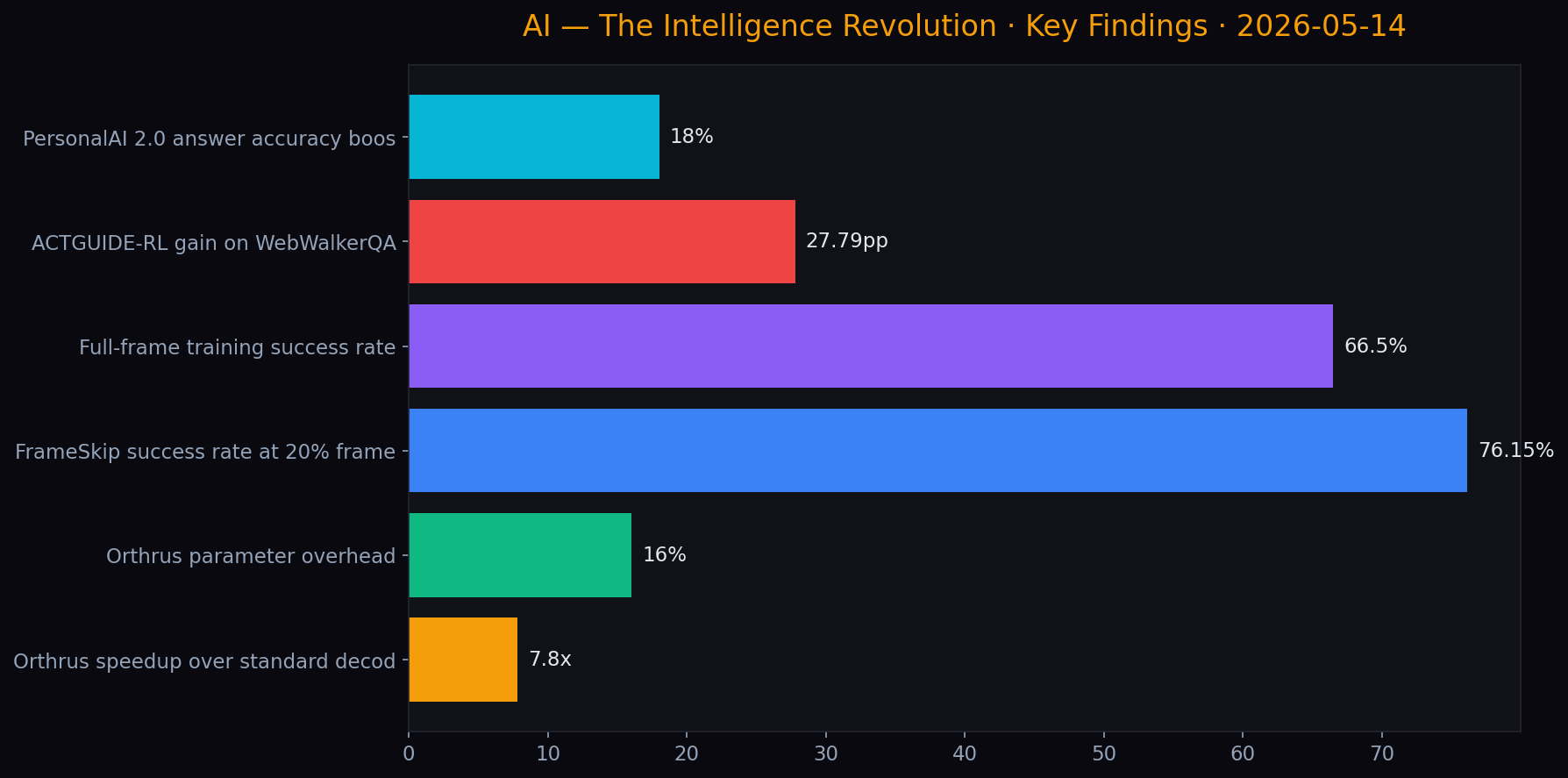
The most technically striking result today comes from Orthrus, a dual-view diffusion architecture that achieves up to 7.8× parallel decoding speedup while preserving the exact predictive distribution of the base model. This is a fundamentally different claim from prior speculative decoding or parallel verification approaches, which inevitably trade quality for speed.
The key insight is architectural: Orthrus maintains a "center view" for autoregressive decoding while using a "context view" for parallel generation, all within a single model with only 16% parameter overhead and O(1) memory cache complexity. The result is mathematically lossless—the output distribution is identical to standard autoregressive decoding, yet the wall-clock speedup approaches an order of magnitude.
This matters because it breaks the apparent tradeoff between speed and quality that has constrained LLM deployment. Previous acceleration methods either required approximation (draft models, early exiting) or introduced quality degradation. Orthrus demonstrates that the tradeoff was never fundamental—it was an artifact of architectural choices. The 7.8× figure isn't just an incremental improvement; it's a proof point that lossless parallelization is achievable, with implications for everything from real-time inference to energy-efficient deployment.
The Quiet Revolution: Efficiency Without Sacrifice
Across today's papers, a pattern emerges. The field is moving beyond "bigger is better" toward a more nuanced understanding of where inefficiencies actually live—and how to fix them without compromising capability.
FrameSkip demonstrates this principle in robotics. The paper's insight is devastatingly simple: VLA training treats every frame equally, but frames are not equal. A robot arm moving through empty space for 90% of a trajectory generates almost no learning signal, yet consumes compute and gradient updates proportional to any other frame. By reallocating supervision toward manipulation-critical transitions—contact, grasp, release—FrameSkip achieves 76.15% macro-average success at 20% frame retention, outperforming the 66.50% from full-frame training. The gain comes not from more data but from better allocation.
The same principle appears in ACTGUIDE-RL, which eliminates the need for expensive supervised fine-tuning (SFT) cold starts in agentic reinforcement learning. Instead of requiring thousands of human-annotated demonstrations to initialize the policy, ACTGUIDE-RL injects scalable action data as plan-style guidance, invoking it only as an adaptive fallback. The result: matching or exceeding SFT+RL pipelines on GAIA (+10.68 pp), WebWalkerQA (+27.79 pp), and XBench (+19.00 pp) with zero cold-start data.
And in PNAPO for text-to-image generation, the innovation is similarly about working smarter rather than harder. By augmenting preference datasets with the prior noise used to generate each image, the method achieves tighter, lower-variance optimization without the expensive forward-noising approximations required by prior approaches.
The common thread: the field is recognizing that compute and data are finite resources, and the path forward lies in using them more intelligently—not just scaling them up.
The Hidden Inefficiencies We've Been Ignoring

What unifies today's most striking results is their identification of previously overlooked inefficiencies in how we train and deploy AI systems.
FrameSkip reveals that in vision-language-action (VLA) training for robotics, the temporal distribution of supervision is fundamentally imbalanced. The paper's authors decompose manipulation trajectories into "critical" frames (contact, grasp, release) and "transitional" frames (all others), finding that the latter dominate training data but contribute little to learning. At 20% frame retention, FrameSkip's targeted supervision achieves 76.15% macro-average success rate versus 66.50% for full-frame training—a 9.65 percentage point gain with 80% less data.
This is not merely an efficiency improvement. It represents a reconceptualization of what training data actually is. The field has been treating every frame as equally informative, but they are not. The rare, manipulation-critical transitions contain almost all the signal, and the long sequences of near-identical frames dilute that signal. FrameSkip identifies and corrects this imbalance.
ACTGUIDE-RL addresses a parallel inefficiency in agentic reinforcement learning: the expensive requirement for supervised fine-tuning (SFT) cold starts. Instead of collecting thousands of human demonstrations to initialize the policy, ACTGUIDE-RL uses scalable action guidance—plan-style reference data that is far cheaper to obtain—and invokes it only when needed via a minimal intervention principle. The result matches or exceeds SFT+RL pipelines without any cold-start data.
MemReread tackles a third form of waste: the tendency of retrieval-augmented memory agents to lose latent evidence and suffer from query interference. By decoupling reading from reasoning and triggering targeted rereading only when memory is insufficient, it recovers lost information without the overhead of intermediate retrieval—achieving consistent improvements on long-context reasoning tasks while maintaining linear time complexity.
Across all these papers, the pattern is consistent: the field is moving from "more data, more compute" to "better allocation of existing resources."
The Hidden Costs We've Been Paying
The papers today collectively expose a set of previously hidden costs in current approaches:
Clinical AI benchmarking. RealICU reveals that evaluating models against what clinicians did rather than what they should have done masks fundamental failures. The benchmark's senior physician annotations expose a recall-safety tradeoff where up to 47.3% of high-recall recommendations are potentially harmful, and anchoring bias where agents preserve early interpretations despite contradictory evidence. The cost of benchmarking against behavioral imitation rather than clinical correctness is measured in patient safety.
Retrieval-augmented memory systems. MemReread identifies two failure modes in current approaches: irreversible latent evidence loss and query interference. The paper's memory-guided rereading mechanism addresses these without architectural changes, demonstrating that the cost of poor design in memory systems is not just performance degradation but fundamental reasoning failures.
VLA training. FrameSkip reveals that standard VLA training wastes supervision on temporally dense but information-poor frames while under-supervising rare but critical transitions. The cost is a 9.65 percentage point gap in success rate—a gap that can be closed simply by reallocating attention at the data level.
Rectified flow alignment. PNAPO shows that prior Diffusion-DPO methods for aligning text-to-image models required expensive forward-noising approximations. By leveraging the straight-line property of rectified flow and augmenting preference data with prior noise, PNAPO achieves better alignment with substantially less compute.
The pattern is clear: the field is discovering that many of its most expensive and complex procedures are not actually necessary. The true frontier of AI research is not building bigger models but building models that make more efficient use of their data, compute, and architecture.
What This Means for the Field
The implications of these findings extend across the AI landscape:
For LLM deployment. Orthrus demonstrates that parallel decoding need not sacrifice quality. The 7.8× speedup with exact distribution preservation means production systems can serve more users with the same hardware—or achieve the same throughput with less. This directly impacts inference costs, latency, and energy consumption.
For agentic AI. ACTGUIDE-RL's elimination of SFT cold-start requirements democratizes agentic RL. Teams without massive supervised fine-tuning budgets can now build capable agentic systems. Combined with MemReread's memory-guided reasoning that avoids retrieval failures, and PersonalAI 2.0's planning-enhanced retrieval, the path to deployable, trustworthy agents becomes clearer.
For robotics. FrameSkip's demonstration that 20% of frames can outperform 100% challenges the data-hungry paradigm of VLA training. The message is not "collect less data" but "collect better data"—or, failing that, train on the right frames. This has immediate implications for robot learning pipelines where data collection remains the primary bottleneck.
Key Takeaways
- Lossless acceleration is possible. Orthrus achieves 7.8× parallel LLM decoding without quality degradation—the first method to preserve exact autoregressive parity while accelerating decoding.
- Data efficiency is the new frontier. Across three papers today (FrameSkip, ACTGUIDE-RL, PNAPO), the consistent theme is achieving more with less—fewer frames, no SFT cold-start data, reduced training compute—by reallocating resources toward what matters.
- Clinical AI needs a new evaluation paradigm. RealICU's demonstration that benchmarking against what clinicians actually do masks dangerous failures (up to 47.3% harmful recommendations at high recall) should force a rethinking of clinical AI evaluation methodology.
- **The frontier is
Published by KHI Research · 2026-05-14 · AI Methodology
Discussion