
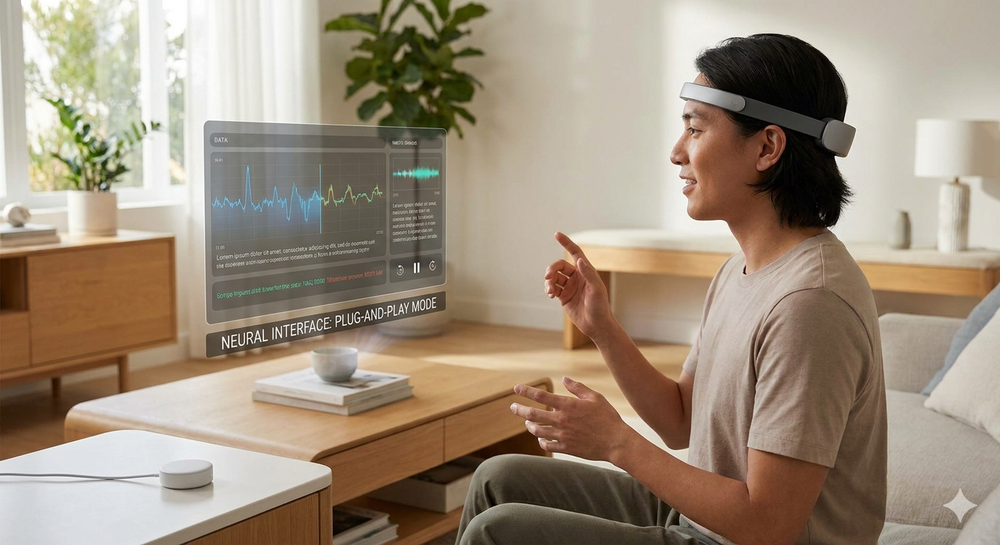
The Era of Plug-and-Play Neural Interfaces
The landscape of Brain-Computer Interface (BCI) research is undergoing a profound transformation, moving away from the laborious requirement of individualized calibration toward a new paradigm of universal adaptability. For over a decade, the promise of direct neural communication has been tempered by the practical necessity of tedious, subject-specific tuning. However, recent syntheses of data from 2026 reveal a decisive shift: the field is finally maturing into a "plug-and-play" reality. By leveraging deep learning architectures and contact-less stimulation methods, researchers are dismantling the historical barriers of inter-subject variability, paving the way for robust, seamless integration of neural decoding into daily human experience.
The End of Per-Session Calibration
Historically, the efficacy of BCI systems hinged on the ability to calibrate models to the unique electrophysiological signature of each user. This approach, while accurate, created a bottleneck: every new session or user required a dedicated training loop, limiting scalability and real-time responsiveness. The latest body of research, however, demonstrates that this constraint is no longer necessary.
Studies utilizing **Domain Generalization** have established that deep learning models trained on diverse, multi-subject datasets can outperform traditional algorithms that rely explicit subject-specific fine-tuning. Counterintuitively, the data suggests that attempting to fine-tune models for individual sessions often degrades performance by overfitting to session-specific noise rather capturing the underlying neural intent. Instead, deeper, larger-scale architectures possess the capacity to absorb inter-subject variability inherently. This finding is reinforced by the emergence of **Open-Set Subject Recognition (OSSR)** frameworks, which disentangle domain-invariant features from individual stylistic nuances. The implication is clear: the industry is transitioning from fragile, custom-built interfaces to robust, generalizable systems capable of decoding neural intentions without prior user exposure.
The Convergence of Multimodal Communication
Parallel to the algorithmic leap in generalization is a structural shift toward **Dynamic Neural Communication**. Traditionally, BCI research has often siloed sensory modalities, analyzing vision, audition, or touch in isolation. The current frontier, however, is defined by convergence. New frameworks successfully integrate computer vision with neural signal processing to decode "visemes"—the visual counterparts of phonemes—directly from brain activity.
This multimodal approach bridges the gap between silent neural processing and observable communicative behaviors. By simultaneously analyzing visual cues and neural signatures, researchers are constructing holistic models of human interaction that are far more resilient than single-modality systems. Furthermore, the concept of **Neurohaptics** has emerged as a critical component of this convergence. By decoding intuitive tactile sensations and touch imagery directly from noninvasive EEG, these systems can interpret the physical world through the brain's response to texture and contact. This synthesis of vision, touch, and auditory processing creates a unified platform for interaction, allowing machines to understand human intent with a depth that mirrors natural cognition.
The Rise of Contact-Less Paradigms
Perhaps the most tangible evolution in this field is the validation of **contact-less stimulation** protocols. For years, high-fidelity neural decoding relied on physical sensors attached directly to the skin or traditional headphones that isolated auditory input. Recent validations of **Airborne Ultrasonic Tactile Display (AUTD)** and **Head-related Impulse Response (HRIR)** systems challenge this hardware dependency.
Research confirms that reliable neural decoding, including the detection of P300 event-related potentials and somatosensory responses, can be achieved without physical contact. Whether delivering ultrasonic stimuli to the palms or utilizing spatial auditory cues through bone conduction, these methods evoke measurable brain responses comparable to classical attached transducers. This shift is significant for practical application; it removes the physical encumbrance of electrodes and the isolation of headphones, offering a more natural, unobtrusive user experience. The success of these contact-less paradigms proves that high signal fidelity does not require physical tethering, opening doors for applications in environments where traditional hardware is impractical or uncomfortable.
Implications for Future Architecture
The convergence of these three trends—zero-calibration algorithms, multimodal fusion, and contact-less hardware—signals a new era for neural interface deployment. For practitioners and technologists, the path forward involves prioritizing architectures that are inherently adaptable. The computational overhead of real-time fine-tuning can be eliminated in favor of deploying pre-trained, domain-generalized models that are ready to interpret neural data from any user immediately.
Moreover, the integration of multimodal inputs suggests that future systems should not process vision or sound in isolation. Building unified representation layers that process visemes and auditory cues simultaneously will yield more robust decoding capabilities. Finally, the validation of contact-less stimuli encourages a reevaluation of hardware design, favoring airborne and spatially distributed stimulation methods that enhance user comfort without sacrificing data quality.
Forward-Looking Questions
As the field advances toward these universal, contact-less systems, several critical questions remain. First, while deeper models have proven superior in domain generalization, does their computational complexity remain feasible for real-time deployment on local consumer hardware without relying on cloud offloading? Second, as frameworks like OSSR rely on learned distributions of "style" or "low-loss" data, how robust are these systems against pathological EEG patterns or extreme outliers that fall outside standard training distributions? Finally, while contact-less stimuli have shown success on specific anatomical sites, does this efficacy hold across diverse anatomical variations or for complex, multi-frequency stimulation protocols? Addressing these challenges will determine the pace at which these theoretical breakthroughs translate into ubiquitous, everyday technologies.
Discussion