
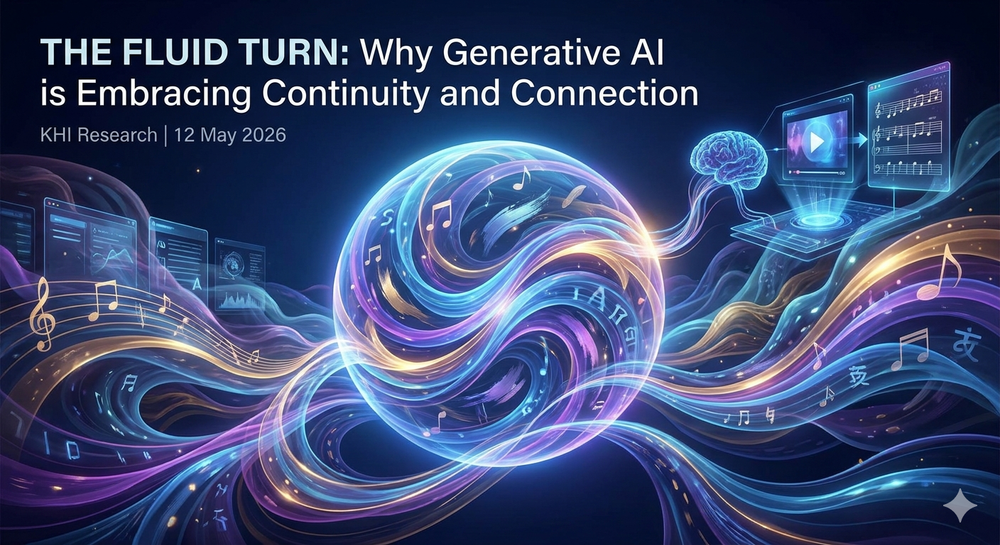
For decades, the digital age has been built on the bedrock of discretization. From the binary switches of early computing to the tokenized words of modern language models, we have relied on breaking the world down into static, countable units to make it computable. Yet, a quiet revolution is unfolding at the frontier of artificial intelligence. Researchers are increasingly realizing that rigid, discrete frameworks often struggle to capture the fluid nuance of human expression, whether in language, music, or vision. The shift toward continuous embedding spaces and hybrid architectures is not merely a technical optimization; it represents a fundamental rethinking of how machines can perceive, create, and interact with the complexity of the world. By moving away from fixed structures, the field is unlocking a new level of adaptability, allowing AI to flow with data rather than forcing data to fit a mold.
The Return of Continuous Dynamics
At the heart of this transformation is a move toward continuity in modeling. Traditional approaches, particularly in language processing, have long depended on discrete tokens as the primary unit of analysis. However, recent breakthroughs, such the *Embedded Language Flows (ELF)* framework, challenge this orthodoxy. By operating within continuous embedding spaces and deferring the act of discretization until the final moment of inference, these models achieve superior perplexity while requiring a fraction of the training data. This approach suggests that the essence of language is not found in its discrete building blocks but in the continuous flow of meaning that connects them.
Similarly, in the realm of symbolic music generation, the field has grappled with the "scalability bottleneck." The sheer complexity of musical sequences often leads to computational costs that grow quadratically, limiting the depth of analysis. The emergence of *Symbolic Music Diffusion with Mamba (SMDIM)* offers a resolution. By integrating structured state space models and the Mamba-FeedForward-Attention block, researchers have reduced computational complexity to near-linear efficiency. This allows for the processing of long, intricate musical sequences without sacrificing the nuanced expressiveness that defines the art form. These developments indicate a broader consensus: to truly understand complex phenomena, models must embrace the continuous nature of the data they seek to represent.
Bridging the Modal Divide
Beyond the shift in mathematical foundations, there is a decisive movement toward cross-modal generalization. For years, AI development was siloed; text models were built for language, vision models for images, and audio models for sound. The current frontier, however, is defined by the convergence of these domains. Surveys on *Text-to-Image* and *Vision-to-Music* generation reveal a growing ambition to create unified frameworks capable of mapping joint distributions across different types of data.
This evolution is driven by the recognition that human cognition is inherently multimodal. We do not experience a poem, a painting, or a symphony in isolation; we experience them in a rich, interconnected context. New frameworks are now leveraging test-time optimization and classifier-free guidance to enable robust adaptation across modalities without the need for full model retraining. This capability marks a significant departure from the past, where applying a model trained on one data type to another required extensive, task-specific adjustments. Today, the focus is on building systems that possess a fluid intelligence, capable of translating concepts from text into visual forms or deriving musical structures from dynamic video inputs, thereby mirroring the integrative nature of human creativity.
From Technical Benchmarks to Societal Frameworks
As these technical capabilities mature, the discourse is expanding to address the broader implications of generative AI. The conversation is no longer confined to accuracy metrics and computational speed; it now encompasses the societal and regulatory structures needed to support these transformative technologies. Recent analyses argue for the formal classification of large-scale generative systems as "core platform services," highlighting a critical need for legal accountability and interoperability mandates.
Furthermore, the integration of AI into fields like materials science and education demonstrates the practical reach of these advancements. Empirical records from collaborative hackathons show that generative AI is moving beyond theoretical potential to become an embedded tool in scientific discovery and learning. By fostering cross-disciplinary collaboration, these tools are enhancing software accessibility and enabling researchers to navigate complex data landscapes with unprecedented ease. This maturation signifies that generative AI is no longer an experimental curiosity but a foundational pillar of modern inquiry, reshaping how knowledge is generated, shared, and understood across disciplines.
What This Means for the Future
The implications of this fluid turn are profound for researchers, engineers, and society alike. For the scientific community, the shift toward continuous and hybrid architectures offers a more powerful lens for examining complex systems, promising deeper insights into the patterns that govern language, art, and nature. For engineers, the reduction in computational complexity and the rise of cross-modal frameworks provide the tools to build more efficient, scalable, and versatile applications that can adapt to real-world demands without constant retraining.
On a societal level, this evolution suggests a future where AI systems are more aligned with human cognition. By embracing continuity and multimodality, these technologies move closer to true partnership with humanity, capable of navigating the ambiguities and rich textures of human experience. The move away from rigid discretization allows for AI that is not just calculating, but understanding—creating a foundation for more intuitive and responsive interactions between humans and machines.
Open Questions at the Frontier
Despite these remarkable strides, the field stands at a threshold with much yet to be explored. As we embrace continuous dynamics, how do we ensure that the nuance of human expression is preserved without the safety net of discrete tokens? As models become more unified across modalities, what new ethical challenges arise regarding the ownership and interpretation of cross-domain creative works? And finally, as generative AI becomes a core infrastructure of society, how do we design governance frameworks that foster innovation while ensuring these powerful tools remain accountable to the communities they serve? These questions will guide the next chapter of this journey, as the world continues to explore the boundless potential of a more fluid intelligence.
Published by KHI Research · 2026-05-12
Discussion