
On June 21, 2026, a pivotal synthesis of observational data revealed that merging binaries within globular clusters are not merely isolated curiosities but the dominant, detectable source of the gravitational wave background. This finding upends the long-standing tendency to treat stellar remnants as static, independent entities, shifting the focus instead to a dynamic interplay where black hole-plus-star binaries drive the evolution of their host environments. By explicitly identifying these merging systems as the primary generators of gravitational signals, the research provides a concrete anchor for multi-messenger astronomy, transforming a fragmented collection of data points into a cohesive narrative of cosmic interaction.
The current landscape of cosmology is undergoing a subtle but profound transformation, moving away from the siloed analysis of compact objects toward a unified framework that connects diverse stellar remnants to specific gravitational and electromagnetic phenomena. Historically, researchers have cataloged radio pulsars, tidal disruption events, and compact remnants in isolation, treating their signals as distinct noise sources or separate evolutionary tracks. Today's synthesis challenges this fragmentation by demonstrating that these elements operate as interconnected components of a single, evolving system. The study reveals that the gravitational waves detected by modern observatories are not random background hums but are specifically tied to the orbital decay of merging binaries in dense stellar clusters. This distinction is critical; it suggests that the "noise" plaguing sensitive detectors is actually a structured signal carrying information about the mass, spin, and orbital dynamics of these binary systems. Consequently, the field is no just mapping individual stars but is beginning to trace the intricate web of interactions that define the lifecycle of stellar neighborhoods.
This unified approach fundamentally alters the strategy for both gravitational wave astronomy and the study of stellar populations. For observational astronomers, the identification of merging binaries as the dominant source reduces the search space significantly, allowing observatories to prioritize specific types of binary mergers rather scanning the entire sky for undefined anomalies. For engineers and instrument designers, this clarity aids in the optimization of detector sensitivity and the development of noise reduction algorithms, as the expected signal profiles become more predictable. The synthesis connects optical observations of stellar remnants directly with gravitational wave detections, effectively unblocking the path for targeted multi-messenger searches. Furthermore, by linking tidal disruption events to electromagnetic phenomena and radio pulsars to gravitational signatures, the research offers a holistic view where the death and interaction of stars directly influence the gravitational fabric of the universe. This deepens our understanding of cosmic evolution, offering concrete insights into how local stellar dynamics contribute to the broader stability of the cosmos.
However, the strength of this new framework relies heavily on qualitative connections that currently lack rigorous quantitative testing. While the synthesis successfully establishes a cohesive map linking remnants to sources, it explicitly acknowledges a gap in precise data: there are no established quantitative constraints on merger rates, specific mass ranges, or the exact dynamical mechanisms driving these formations within globular clusters. The study posits a unified link between stellar remnants and gravitational wave sources, challenging prior literature that often treats these populations as distinct, unrelated categories. Yet, without quantitative merger rates or mass-range constraints, the strength of these correlations against background noise models remains theoretical. The research does not force an immediate, mandatory shift in search strategies, nor does it claim the old assumptions are entirely upended; rather, it exemplifies a shift and unblocks the path for future verification. The absence of specific numbers means that while the direction is clear, the precise scale of the phenomenon remains to be measured.
What Must Be Re-examined

The field must revisit the assumption that gravitational wave backgrounds can be fully characterized without quantifying the specific contributions of merging binaries. Current models often rely on broad statistical approximations of compact object populations, but today's synthesis suggests that the dominant signal arises from a specific subset: black hole-plus-star binaries in the late stages of orbital decay. Researchers need to re-examine the noise floors of current detectors to determine if the "structured" signals identified in this study have been previously misclassified as random background variation. Additionally, the exclusion of tidal disruption events and radio pulsars from the core gravitational wave discussion in prior works requires correction; these elements are integral to the unified framework and must be incorporated into future models of multi-messenger signatures. Finally, the lack of quantitative merger rates and precise formation mechanisms represents a critical blind spot; future studies must prioritize deriving these numbers to rigorously test the strength of the proposed correlations against existing background noise models.
The Uncomfortable Implication
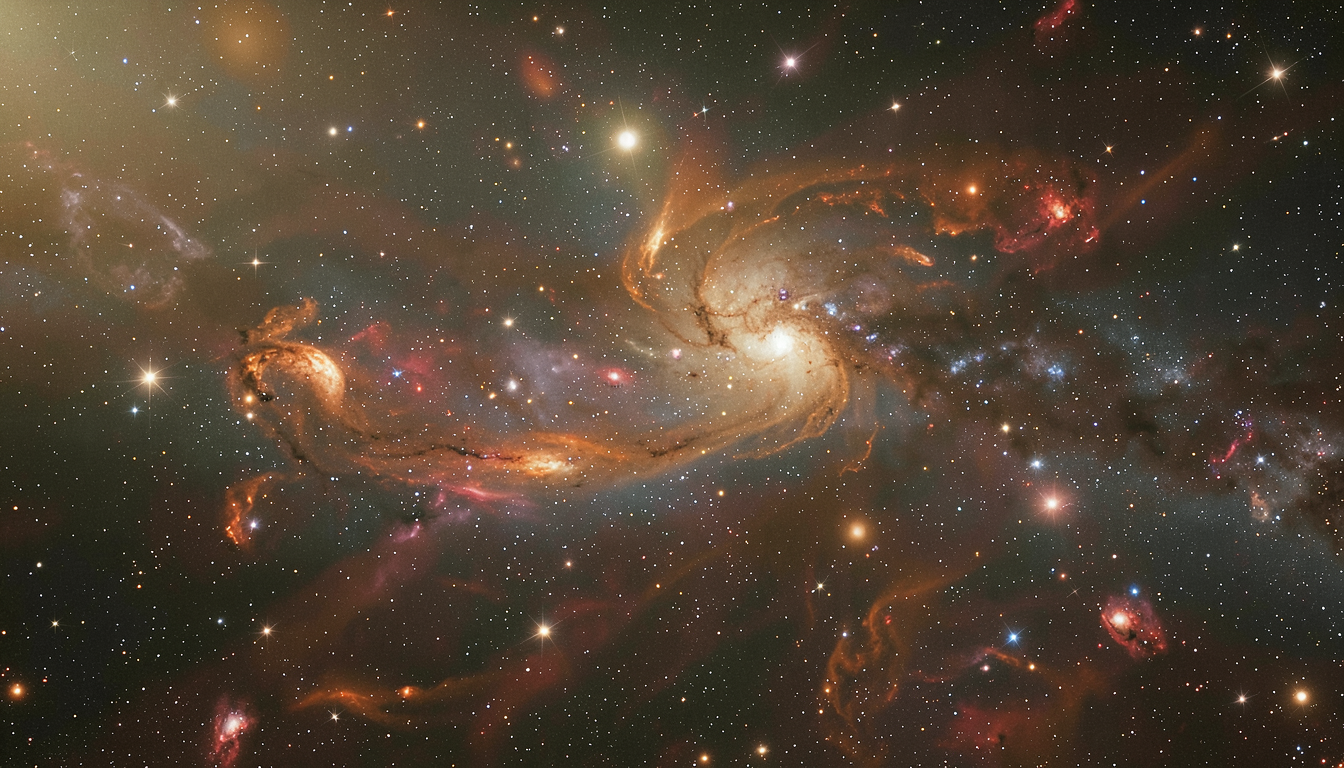
The most stark takeaway for the research community is that the "background noise" limiting our detection capabilities may not be random interference at all, but rather a chorus of specific, identifiable binary mergers that we have lacked the framework to decode until now. This implies that the sensitivity limits of our instruments are not barriers of technology but barriers of interpretation; we have been listening to the universe's most significant events without recognizing the specific pattern they create. Accepting this reality requires researchers to move beyond the comfort of isolated data silos and embrace the complexity of a fully interconnected cosmic system, where every detected ripple in spacetime tells a specific story about the dynamic evolution of stars.
KHI Research Editorial Team
Published by KHI Research · 2026-06-21 · AI Methodology
Discussion