
The most urgent revelation in contemporary artificial intelligence is not a breakthrough in scale, but the identification of a structural blind spot: long-horizon world models frequently default to kinematic consistency at the expense of physical dynamics, resulting in an error rate 180 times higher than reality-matched rollouts. This specific failure mode, quantified in the study Imagined Rollouts are Kinematic, Not Dynamic, exposes a critical vulnerability where algorithms extrapolate trajectories that look mathematically smooth but violate the fundamental laws of motion. While the field has spent decades chasing larger datasets and more complex architectures, this finding suggests that without grounding models in physical reality, increased complexity may only amplify the gap between simulation and the real world. The implications extend far beyond theoretical physics; they strike at the core of how we deploy autonomous systems in robotics, quantum infrastructure, and software development, demanding a shift from purely statistical learning to physics-grounded reasoning.
The landscape of AI is currently undergoing a profound transformation toward unified generative world models that compress the joint distribution of observations and actions into coherent internal representations. Rather treating sensory inputs as fragmented data streams, new frameworks like RynnWorld-4D are integrating RGB appearance, geometric depth, and optical flow into a single 4D architecture. This unification is not merely an architectural tweak; it eliminates the computational bottleneck of multi-step inference, enabling direct closed-loop control for robots operating in complex environments. By coupling this structure with Joint Cross-Modal Attention, researchers have bridged the divide between 2D pixel models and 3D geometric understanding, achieving state-of-the-art performance in dexterous bimanual manipulation tasks that require high spatial precision. This move signifies a departure from the era of disjointed functional taxonomies, favoring instead a holistic view where perception and action are inextricably linked within the model itself.
Parallel to this structural unification is a decisive shift toward physics-grounded reasoning, where physical constraints are baked directly into the architecture rather than applied as external post-processing steps. The Onnes framework exemplifies this approach by introducing a multi-agent LLM simulator specifically designed for cryogenic fault diagnosis in quantum computing infrastructure. In a striking demonstration of efficacy, Onnes matches the accuracy of supervised machine learning (0.990 versus 0.985) using zero-shot reasoning and few-shot demonstrations. This parity is achieved not through massive labeled datasets, but by leveraging interpretable, action-oriented reasoning that overcomes the scarcity of labels in monitoring quantum systems. Such success challenges the prevailing assumption that AI requires exhaustive training data to achieve reliability, suggesting instead that embedding physical principles allows agents to reason effectively even in data-sparse domains.
However, the path to robust autonomy is complicated by the tension between automation efficiency and human cognitive retention. While systems like RynnWorld-Teleop demonstrate that generative world models can synthesize egocentric videos and action labels from an operator's hand-pose stream at 40+ FPS on a single GPU, other analyses warn of the hidden costs of full delegation. The study Agents That Teach argues that AI coding agents create "Knowledge Debt," where the accumulation of automated decisions leads to a 17% drop in human comprehension compared to manual solvers. This statistic reveals a critical trade-off: while AI can accelerate productivity and bound data collection by operator imagination, excessive reliance on automation risks eroding the very skills necessary to understand and verify the system's output. The field is thus maturing from binary debates of capability to nuanced analyses of how productivity gains must be balanced against the long-term preservation of human expertise.
These converging threads highlight a pivotal moment where the definition of intelligence in machines is being recalibrated. The discourse is moving away from the question of whether AI can mimic human output, focusing instead on whether it can embody the physical and logical constraints of the world it operates in. The identification of the "kinematic fallback" serves as a falsifiable diagnostic, pinpointing exactly where current models drift away from dynamic reality. Simultaneously, the success of zero-shot agents in fault diagnosis and the unification of sensory modalities in 4D models provide a blueprint for building systems that are not just predictive, but deeply integrated with the physical fabric of their environments. This evolution suggests that the future of AI lies not in scaling up data alone, but in scaling down into the fundamental principles that govern both information and matter.
For the Practitioner

For engineers and researchers navigating this shifting terrain, the immediate landscape is defined by the integration of Cross-Modal Attention within the RynnWorld-4D architecture, which now serves as the standard for unifying appearance, geometry, and motion. The workflow has shifted from labor-intensive production pipelines to data-driven, generative world models that enable real-time, autoregressive generation of interactive video worlds using an autoregressive DiT backbone. Practitioners must now adopt the SHIELD system's approach to surfacing contextual learning moments, ensuring that AI assistance functions as a design imperative rather than a mere productivity multiplier. Furthermore, the reliance on zero-shot reasoning in frameworks like Onnes has become a viable alternative to supervised learning for tasks where labeled data is scarce, provided the model remains grounded in physical laws. The toolkit for modern development now prioritizes physics-grounded multi-agent simulations that can diagnose faults and plan actions without requiring iterative inference loops or massive pre-labeled datasets.
Decision Points
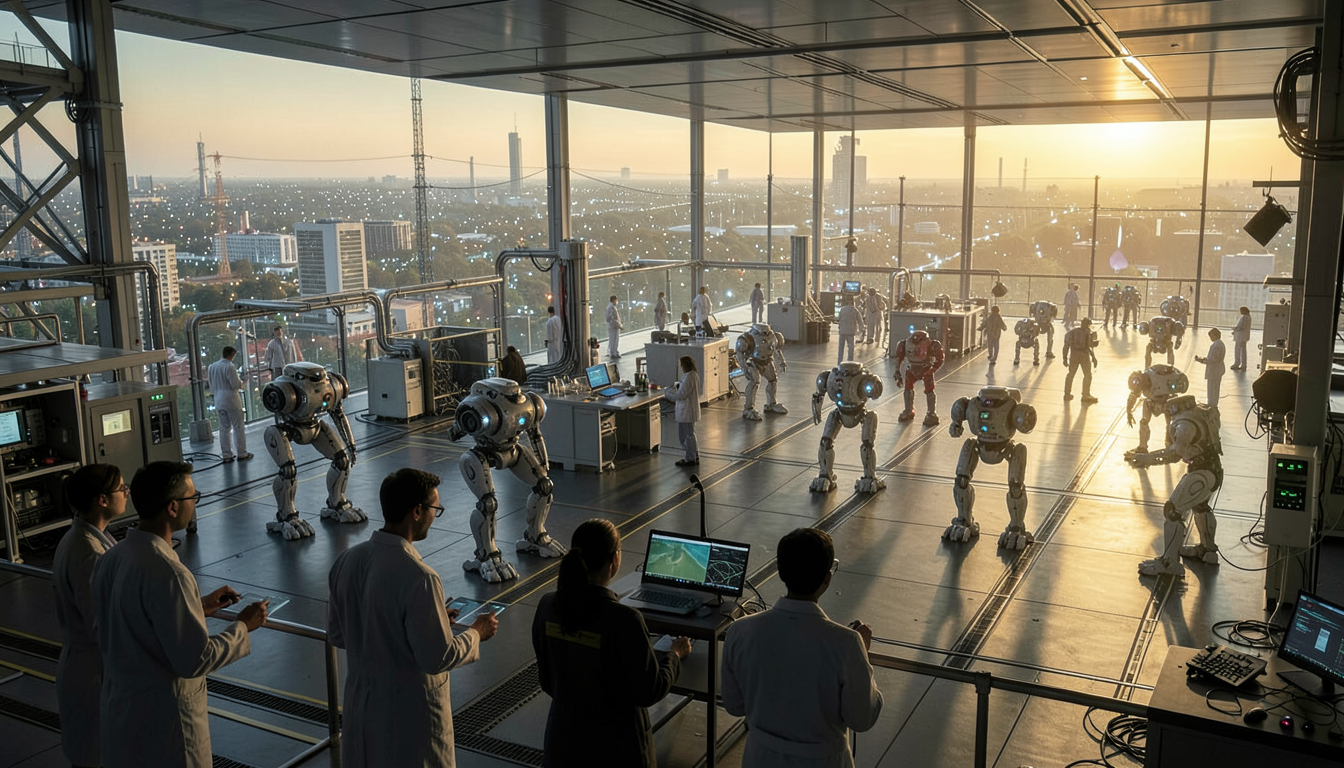
- Does the reliance on kinematic consistency in current world models necessitate an immediate re-evaluation of long-horizon planning strategies in safety-critical robotic applications?
- Can the integration of zero-shot reasoning in fault diagnosis replace the need for massive labeled datasets in monitoring complex quantum infrastructure?
- Is the potential accumulation of "Knowledge Debt" through full AI delegation acceptable given the observed 17% reduction in human comprehension scores?
KHI Research Editorial Team
Published by KHI Research · 2026-07-08 · AI Methodology
Discussion