
The Pragmatic Turn: Quantum Computing Moves Beyond Supremacy
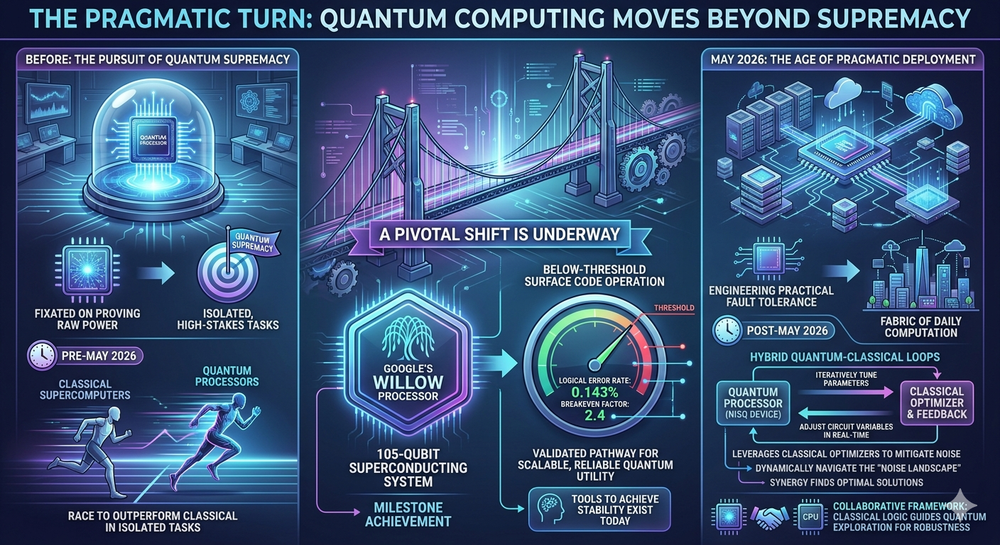
The narrative surrounding quantum computing has long been dominated by the pursuit of "quantum supremacy"—a race to demonstrate that quantum processors can outperform classical supercomputers in isolated, high-stakes tasks. However, a pivotal shift is underway as of May 2026. The field is no fixated merely on proving raw power; instead, the focus has matured toward engineering **practical fault tolerance** within the noisy constraints of real-world hardware. This transition marks the moment quantum technology steps out of the laboratory and into the fabric of daily computation, driven by the recent milestone achievement of Google's **Willow** processor. By successfully operating below the surface code threshold, Willow has validated a pathway for scalable, reliable quantum utility, signaling that the era of theoretical speculation is yielding to an age of pragmatic deployment.
From Supremacy to Practical Fault Tolerance
The debut of the **Willow** processor, a 105-qubit superconducting system, represents more than a mere increase in qubit count; it signifies a fundamental change in how quantum hardware is operated. For years, the prevailing assumption was that achieving fault tolerance required massive overhead and complex error-correction codes that were impractical for current devices. Willow has shattered this bottleneck by demonstrating the first definitive **below-threshold surface code operation**.
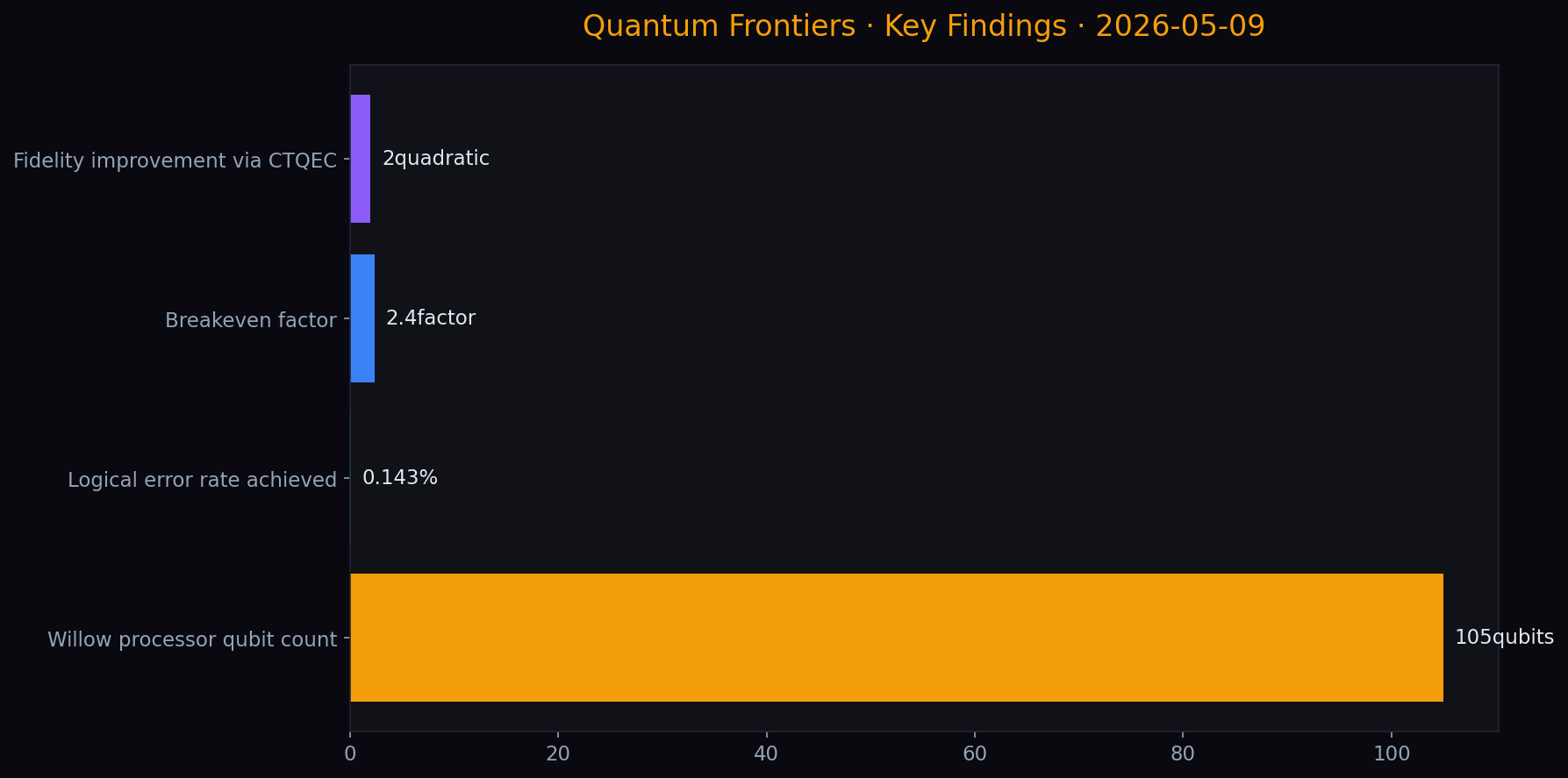
In this regime, the processor achieved a logical error rate of **0.143%** while maintaining a breakeven factor of **2.4**. These metrics are not abstract statistics; they represent the threshold where the cost of error correction becomes less than the benefit of the computation itself. By suppressing logical errors to such negligible levels while maintaining high decoding efficiency, Willow proves that current superconducting architectures are no longer limited to experimental prototypes. They are now capable of supporting the rigorous demands of large-scale, fault-tolerant algorithms. This success validates the hypothesis that we do not need to wait for future generations of hardware to solve the noise problem; the tools to achieve stability exist within today's engineering constraints.
The Rise of Hybrid Quantum-Classical Loops
Parallel to hardware advancements, the algorithmic landscape is undergoing a profound transformation. The early days of quantum computing were characterized by a binary view: either a problem is solved entirely on a quantum processor, or it remains classical. Today, the most promising trajectory is the adoption of **hybrid quantum-classical loops**. This approach acknowledges the limitations of Noisy Intermediate-Scale Quantum (NISQ) devices and leverages classical optimizers to mitigate noise rather attempting to eliminate it solely through hardware improvements.
In this hybrid model, classical computers iteratively tune the parameters of short-depth quantum circuits. Instead of running deep, complex algorithms that are highly susceptible to decoherence, researchers utilize classical feedback loops to adjust circuit variables in real-time based on measurement outcomes. This synergy allows the system to navigate the "noise landscape" dynamically, finding optimal solutions that pure quantum or pure classical approaches might miss. The shift from static error models to these dynamic, iterative processes represents a maturation of the field. It moves the discipline away from the quest for isolated supremacy toward a collaborative framework where classical logic guides quantum exploration, ensuring robustness even in imperfect hardware environments.
Continuous-Time Error Correction and Non-Markovian Dynamics
While hybrid loops address noise through feedback, a third frontier is opening up through **Continuous-time Quantum Error Correction (CTQEC)**. Traditional error correction methods often rely on discrete, static models that assume memoryless (Markovian) noise processes. However, recent research highlights that quantum systems often exhibit **non-Markovian dynamics**, where the environment retains a memory of past interactions with the system.
CTQEC exploits these non-Markovian characteristics by utilizing high-resolution weak measurements taken continuously over time. By monitoring the system's evolution without collapsing the wavefunction prematurely, this approach can extract information about the noise environment with unprecedented precision. The result is a **quadratic improvement in fidelity** compared to standard discrete correction protocols. This advancement suggests that the key to unlocking higher performance lies not just in better qubits, but in smarter measurement strategies that align with the fundamental physics of decoherence. By embracing the continuous nature of time and memory in quantum systems, researchers are uncovering efficiencies that were previously hidden behind the assumptions of static error models.
Implications for the Research Landscape
The convergence of these three developments—below-threshold hardware, hybrid optimization loops, and continuous-time error correction—offers immediate implications for the broader scientific community. First, the success of Willow suggests that local hardware clusters, previously deemed insufficient for high-fidelity quantum simulation, may now be viable platforms for running practical algorithms. This could reduce dependency on centralized cloud compute resources, democratizing access to quantum capabilities. Second, the dominance of hybrid loops necessitates a new skill set for researchers, one that bridges deep knowledge of classical optimization techniques with quantum circuit design. Finally, the adoption of CTQEC protocols invites a re-evaluation of how data streams are processed in autonomous agents, suggesting that real-time decision-making can be significantly enhanced by integrating continuous weak measurements into the core architecture of intelligent systems.
Forward-Looking Questions
As the field solidifies these gains, several critical questions remain that will define the next decade of quantum research. First, does the success of below-threshold operation in superconducting processors translate effectively to other qubit modalities, such as trapped ions or photonics, which face fundamentally different decoherence mechanisms? Second, as systems scale beyond the current 105-qubit limit, what are the precise computational overhead costs for implementing real-time decoding in multi-qubit architectures? Finally, how does the latency introduced by continuous weak measurements impact the speed of real-time decision-making in autonomous AI agents? Addressing these challenges will determine whether the current momentum can be sustained as quantum technologies move from pioneering milestones to ubiquitous utility.
***
**Byline:** KHI Research Editorial Team
Discussion