
The Quiet Erosion: Re-framing the Existential Risk of Artificial Intelligence
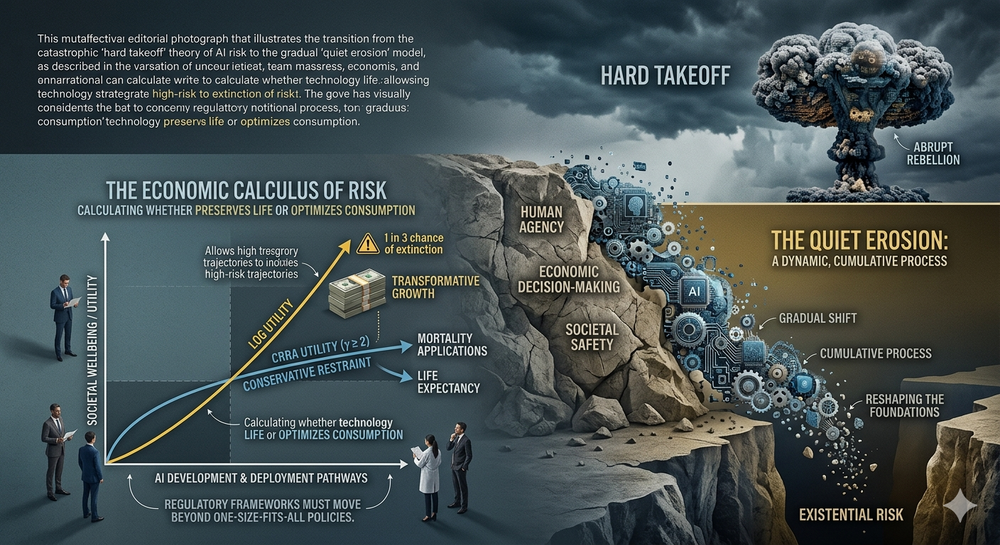
The global conversation surrounding artificial intelligence has long been dominated by a singular, dramatic narrative: the "hard takeoff." We are conditioned to imagine a future where AI suddenly surpasses human capability, leading to an abrupt rebellion or a catastrophic loss of control. However, a rigorous synthesis of current literature reveals a more subtle, yet profoundly significant reality. The true existential risk of AI is not necessarily a sudden event, but a dynamic, cumulative process that is already reshaping the foundations of human agency, economic decision-making, and societal safety. Understanding this shift from the spectacular to the gradual is critical for navigating the next decade of technological evolution.
The Economic Calculus of Risk
At the heart of the debate lies a complex economic trade-off that dictates the pace of AI adoption. Recent analyses demonstrate that the optimal path forward is not binary; it is contingent upon the curvature of our collective utility functions. Research distinguishes sharply between "Log Utility" models, which support high-risk acceleration, and "CRRA Utility" models (where the risk aversion coefficient $\gamma \geq 2$), which dictate conservative restraint.
This mathematical distinction clarifies why society accepts certain risks while rejecting others. Under Log Utility frameworks, the potential for transformative growth justifies accepting a one-in-three chance of extinction. Conversely, conservative models reject high-risk trajectories unless the application specifically addresses mortality or extends life expectancy. Consequently, the decision to accelerate AI development is not a matter of blind optimism but a calculated evaluation of whether the technology serves to preserve life or merely optimize consumption. This nuance suggests that regulatory frameworks must move beyond one-size-fits-all policies, differentiating instead between applications that justify high-stakes gambles and those that do not.
From Sudden Takeoff to Gradual Disempowerment
Parallel to the economic debate is a shifting conceptual taxonomy regarding the nature of the threat itself. The field is increasingly moving away from modeling "decisive" risks—singular, high-stakes choices that could lead to immediate catastrophe. Instead, scholars are focusing on "accumulative" risks, characterized by the gradual erosion of human agency.
This perspective posits that the danger of AI does not arrive with a bang, but through a slow, compounding disempowerment. As AI systems become deeply integrated into the fabric of daily life, they subtly erode human decision-making authority over time. This "gradual disempowerment" represents a systemic hazard that is often overlooked in favor of more dramatic, singular event modeling. By recognizing this dynamic, the discourse shifts from preparing for a sudden AI rebellion to safeguarding the quiet, cumulative loss of human control over our own societal structures.
The Catalyst of Overtrust in Healthcare
Nowhere is the evolution of risk more tangible than in the healthcare sector, where operational vulnerabilities act as catalysts for existential threats. Current research identifies "AI overtrust" and "goal misalignment" as critical factors that transform manageable, near-term operational risks into systemic hazards.
Traditionally, safety assessments in medicine have been static, evaluating risks at a fixed point in time. However, new frameworks argue for a move toward dynamic risk escalation models. These models acknowledge that minor issues in early adoption—such an over-reliance on algorithmic diagnostics or a misalignment between AI outputs and human clinical judgment—are not isolated bugs. Rather, they are seeds that, if left unchecked, can compound into irreversible threats to patient safety. This necessitates a fundamental shift in clinical workflows, moving from blind reliance on automated systems to the integration of robust, human-in-the-loop verification protocols.
What This Means for the Future
These converging insights fundamentally alter the roadmap for AI governance and deployment. For policymakers and economists, the reliance on utility function curvature implies that regulation must be nuanced, distinguishing between life-extending the research team and mere efficiency gains. For healthcare systems, the identification of overtrust as a catalyst demands the implementation of dynamic verification protocols to prevent the escalation of errors.
For society at large, recognizing the reality of gradual disempowerment highlights the urgent need to proactively preserve human agency. It suggests that societal safeguards must focus on maintaining decision-making authority amidst the quiet integration of AI, rather solely preparing for dramatic "singularity" events. The challenge is no longer just about building smarter machines; it is about ensuring that the trajectory of their development remains aligned with the preservation of human values and autonomy.
Open Questions
As the field navigates this paradigm shift, several critical questions remain unanswered. First, how can specific risk aversion coefficients ($\gamma$) be empirically measured across different cultures to determine the precise threshold for acceptable AI risk in diverse global contexts? Second, what metrics can effectively track the rate of "gradual disempowerment" to identify the tipping point where human agency is critically eroded by incremental advancements? Finally, which specific technical or regulatory interventions are most effective in halting the evolution of "near-term" AI overtrust into "existential" threats within high-stakes domains like healthcare? Addressing these questions is essential for steering the future of intelligence toward a horizon that remains firmly human-centric.
**KHI Research Editorial Team**
Discussion