
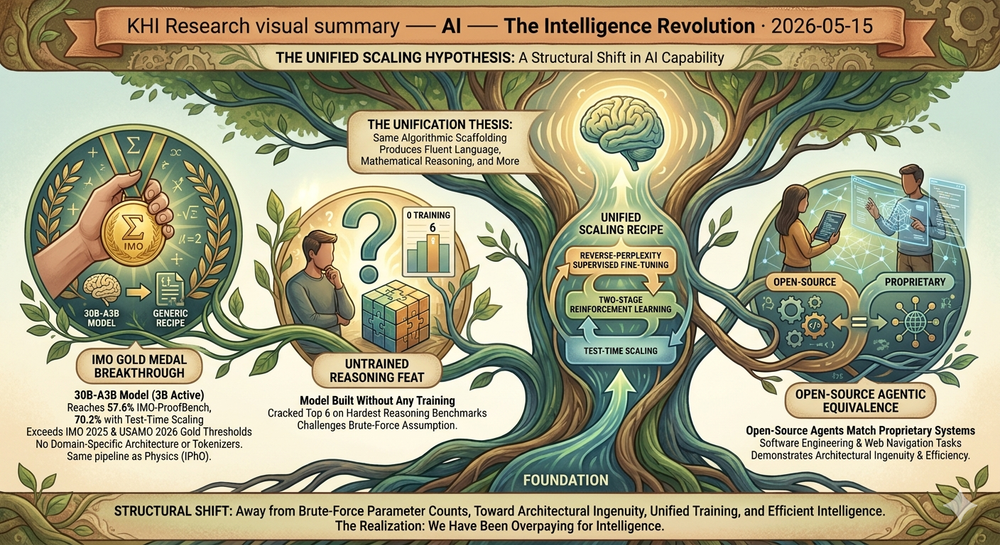
On May 15, 2026, the research community received three distinct messages, each delivered with the force of a hammer strike. A 30-billion-parameter model won a gold medal on the International Mathematical Olympiad. Another model, built without any training at all, cracked the top six on one of the hardest reasoning benchmarks. And a third set of results demonstrated that open-source agentic systems can now match proprietary ones on software engineering and web navigation tasks. These are not incremental improvements. They represent a structural shift in how the field thinks about capability scaling—away from brute-force parameter counts and toward architectural ingenuity, unified training recipes, and the realization that we have been dramatically overpaying for intelligence.
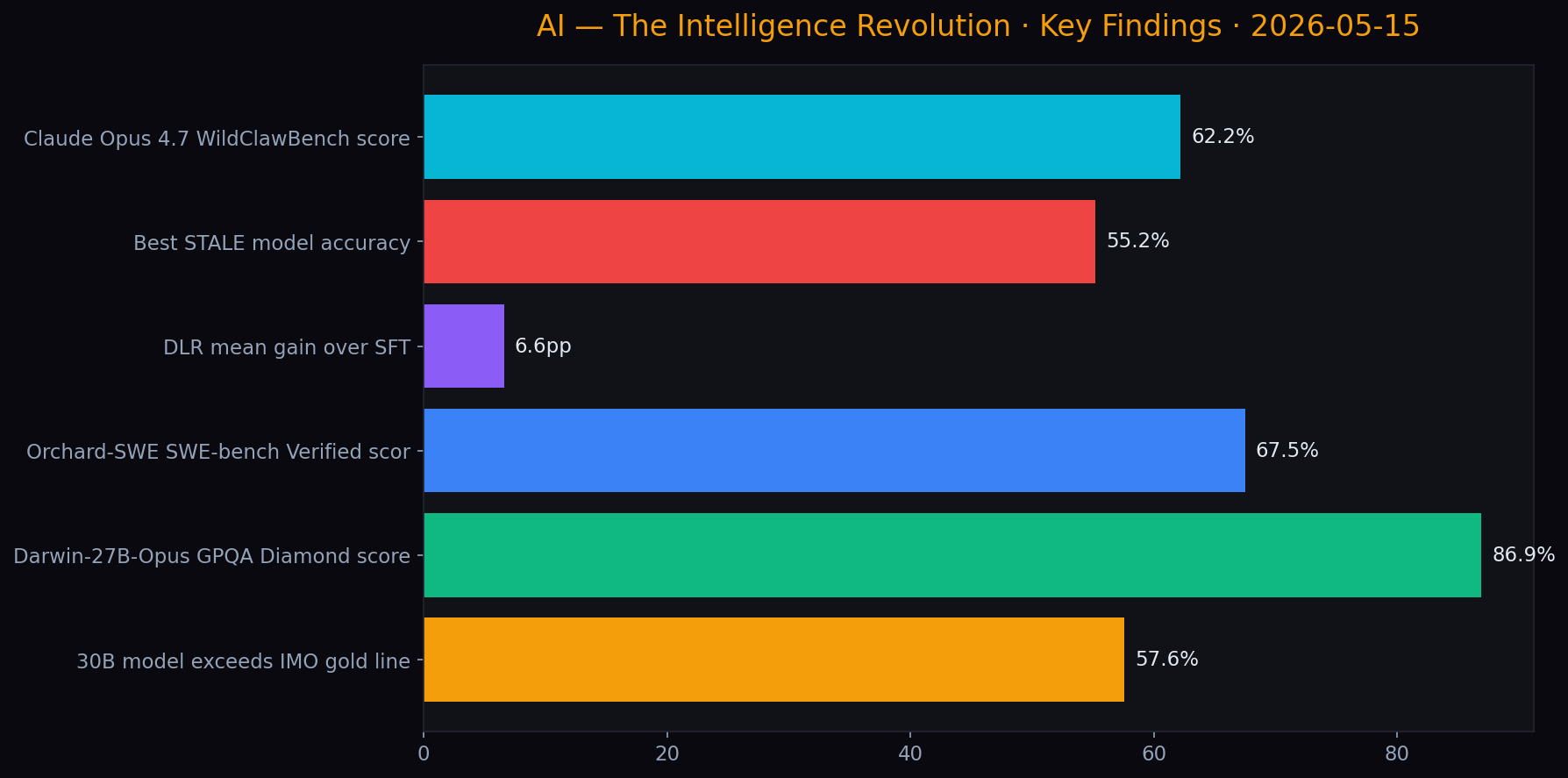
The Unified Scaling Hypothesis

The most technically consequential paper today is SU-01, which achieves what its authors call a "unified scaling recipe" for mathematical reasoning. The model, a 30B-parameter architecture with 3B active parameters (30B-A3B), reaches 57.6% on IMO-ProofBench and 70.2% with test-time scaling—sufficient to exceed both the IMO 2025 gold medal threshold and the USAMO 2026 gold line. The achievement is notable not because it is the best mathematical reasoning model ever built, but because of how it was built.
The recipe is strikingly generic: reverse-perplexity supervised fine-tuning, followed by two-stage reinforcement learning, capped with test-time scaling. There are no domain-specific architectures, no specialized math tokenizers, no curriculum learning schedules designed by hand. The same pipeline that produced gold-medal performance on the International Mathematical Olympiad also works for physics problems at the IPhO level. This is the unification thesis in action: the same algorithmic scaffolding that produces fluent language also produces rigorous mathematical reasoning, provided you scale the training methodology rather than the model.
The implications are profound. If mathematical reasoning is not a special capability requiring specialized architectures but rather an emergent property of a sufficiently general training pipeline, then the bottleneck shifts from model design to data quality and training methodology. The field's obsession with novel architectures may have been, at least partially, a distraction from the more prosaic work of getting the training recipe right.
The Training-Free Revolution
While SU-01 demonstrates what can be achieved with careful training, the Darwin Family results suggest an even more provocative possibility: perhaps training itself is optional. Darwin-27B-Opus achieves 86.9% on GPQA Diamond—ranking sixth among 1,252 evaluated models—without any gradient updates whatsoever. Instead, it uses MRI-Trust Fusion, an evolutionary merging technique that recombines existing checkpoints in weight space, guided by a 14-dimensional adaptive genome and a learnable trust parameter that balances layer-importance signals against evolutionary search.
This is not distillation. This is not fine-tuning. This is a fundamentally different approach to capability: treating model weights as a searchable space where latent capabilities can be reorganized rather than learned. The Architecture Mapper component even enables cross-architecture breeding—merging Transformer and Mamba checkpoints into single models. The result is a 27B-parameter model that outperforms its foundation model on every metric, without a single gradient update.
The implications are uncomfortable for the prevailing orthodoxy. The dominant narrative has been that frontier reasoning requires expensive post-training pipelines: instruction tuning, reinforcement learning from human feedback, distillation from larger models. Darwin challenges this directly, suggesting that many of these capabilities are latent in pretrained checkpoints and simply need to be recombined correctly. If this scales—and the paper provides evidence it does, with the ablation studies showing consistent improvements across model sizes—then the marginal cost of improving reasoning capability drops toward zero. The compute expenditure shifts from training to inference-time search through weight space, which is orders of magnitude cheaper.
Beyond Benchmarks: The Coming Infrastructure Revolution

While SU-01 and Darwin-27B-Opus advance the frontier of what models can do, Orchard addresses how they will do it in practice. The Orchard framework is a Kubernetes-native agentic system that decouples sandbox lifecycle management from agent harnesses, training pipelines, and task domains. This is infrastructure work, and it matters because the hardest problem in AI deployment is not building models but integrating them into reliable systems.
The paper introduces three domain-specific agents. Orchard-SWE (30B MoE) achieves 67.5% on SWE-bench Verified, a new state-of-the-art for its size class, doing so via "credit-assignment SFT"—learning from productive segments of trajectories even when the overall attempt fails. Orchard-GUI (4B) reaches 68.4% average on web agent benchmarks, competitive with proprietary systems many times its size. Orchard-Claw hits 73.9% pass@3 on Claw-Eval. These are not frontier-pushing numbers—they are frontier numbers. A 30B model beating much larger systems on software engineering tasks. A 4B model competing with frontier multimodal agents. The secret is not scale but smart data curation and training methodology.
The benchmark itself—WildClawBench—is worth examining. It introduces 60 human-authored, bilingual, multimodal tasks executed in native-runtime Docker containers with real tools (shells, browsers, file systems), moving beyond the mock-service APIs that have dominated agent evaluation. The best model achieves 62.2%; every other model stays below 60%. Multimodal tasks trail pure-text, and harness choice alone shifts performance by up to 18 points. The field is finally building evaluations that reflect real-world complexity, and the results show just how much room there is for improvement.
The Quiet Revolution in World Models
SANA-WM represents a different kind of frontier: not reasoning but perception. It is a 2.6B-parameter open-source world model natively trained for one-minute, 720p video generation with precise 6-DoF camera control. The architecture is a Hybrid Linear Diffusion Transformer combining frame-wise Gated DeltaNet for efficient recurrent context aggregation with periodic softmax attention for exact long-range recall.
The numbers are striking: training requires only ~213K public video clips and 15 days on 64 H100 GPUs. A distilled variant with NVFP4 quantization runs on a single RTX 5090 in 34 seconds. This is not a laboratory curiosity—it is a practical tool that democratizes long-horizon world modeling.
The implications for robotics, autonomous driving, and simulation are immediate. When a world model can generate one-minute, 720p video with precise camera control on a single consumer GPU, the barrier to entry for research drops dramatically. Small labs and even individual researchers can now experiment with world models that were previously the domain of large corporations.
What This Means
The collective picture from today's papers is that 2026 has become the year of democratization. The barriers to entry are falling across multiple fronts:
- Reasoning: SU-01 shows that gold-medal mathematical performance no longer requires 100B+ parameters or proprietary architectures. A 30B model with a clean, unified pipeline can achieve what was once thought exclusive to the largest frontier models.
- Post-training: Darwin-27B demonstrates that expensive post-training pipelines—instruction tuning, RLHF, distillation—are not the only path to high capability. Training-free evolutionary merging can reorganize latent capabilities in existing checkpoints, challenging the orthodoxy that "more training data and more compute" is the only way forward.
- Agents: Orchard provides an open-source, Kubernetes-native agentic framework with domain-specific models that are competitive with proprietary systems. The "agentic AI" future is not locked behind closed APIs.
- World Models: SANA-WM democratizes minute-scale, high-resolution video generation with precise camera control, running on a single consumer GPU.
The pattern is clear: the frontier is being democratized. What was once accessible only to a handful of well-resourced labs is now available to the broader research community. This is not a single breakthrough but a systematic lowering of barriers across the entire AI landscape.
What This Means For Research Community
For researchers, the implications are profound. The SU-01 results suggest that the path to advanced mathematical reasoning does not require proprietary data or specialized architectures—just a well-designed pipeline and sufficient compute. The Darwin results challenge the assumption that training is necessary for capability, while Orchard provides the infrastructure to deploy these capabilities in real-world settings.
For engineers building production systems, the key takeaway is that the bottleneck has shifted. It is no longer about model architecture or training data but about systematic engineering: designing effective pipelines, managing state, handling memory, and building robust evaluation frameworks. The SU-01 pipeline—reverse-perplexity SFT plus two-stage RL plus test-time scaling—is a recipe that can be replicated. The Darwin merging approach is training-free and architecture-agnostic. Orchard is Kubernetes-native and open-source.
The societal implications are equally significant. When a 30B model can achieve gold-medal performance on the International Mathematical Olympiad, when training-free model merging produces top-6 reasoning capability, when open-source frameworks enable minute-long video generation on a single consumer GPU—the democratization of AI capability is accelerating. The frontier is no longer the exclusive domain of massive compute clusters and proprietary data. It is accessible to any lab with sufficient resources to run these open-source tools.
Key Takeaways
- SU-01 (30B-A3B) achieves gold-medal IMO/IPhO performance with a unified pipeline—no domain-specific architectures, no proprietary data. Mathematical reasoning at the
Published by KHI Research · 2026-05-15 · AI Methodology
Discussion