
The cosmos is not ending anytime soon—and the evidence for its accelerated expansion may be far less exotic than headlines suggest. Two papers published today deliver a one-two punch to cosmological alarmism. The first, using nothing but the orbits of planets in our own solar system, rules out any "Big Rip" apocalypse within the next 30 years. The second, a rigorous Bayesian reanalysis of the same DESI data that recently made headlines for "dynamical dark energy," finds that phantom crossing—the key signature of a rip-bound universe—vanishes under proper statistical scrutiny. Together, these results represent a significant recalibration of our cosmological expectations.
Solar System as a Dark Energy Laboratory
The Big Rip scenario has long occupied a peculiar space in cosmology: theoretically possible, popularly terrifying, but empirically untestable by traditional means. The standard approach to constraining dark energy—measuring the expansion history of the universe via supernovae, baryon acoustic oscillations, and cosmic microwave background anisotropies—is fundamentally limited when it comes to imminent singularities. If a Big Rip were to occur within decades or centuries, the relevant dynamics happen on timescales far too short for cosmological probes to resolve.
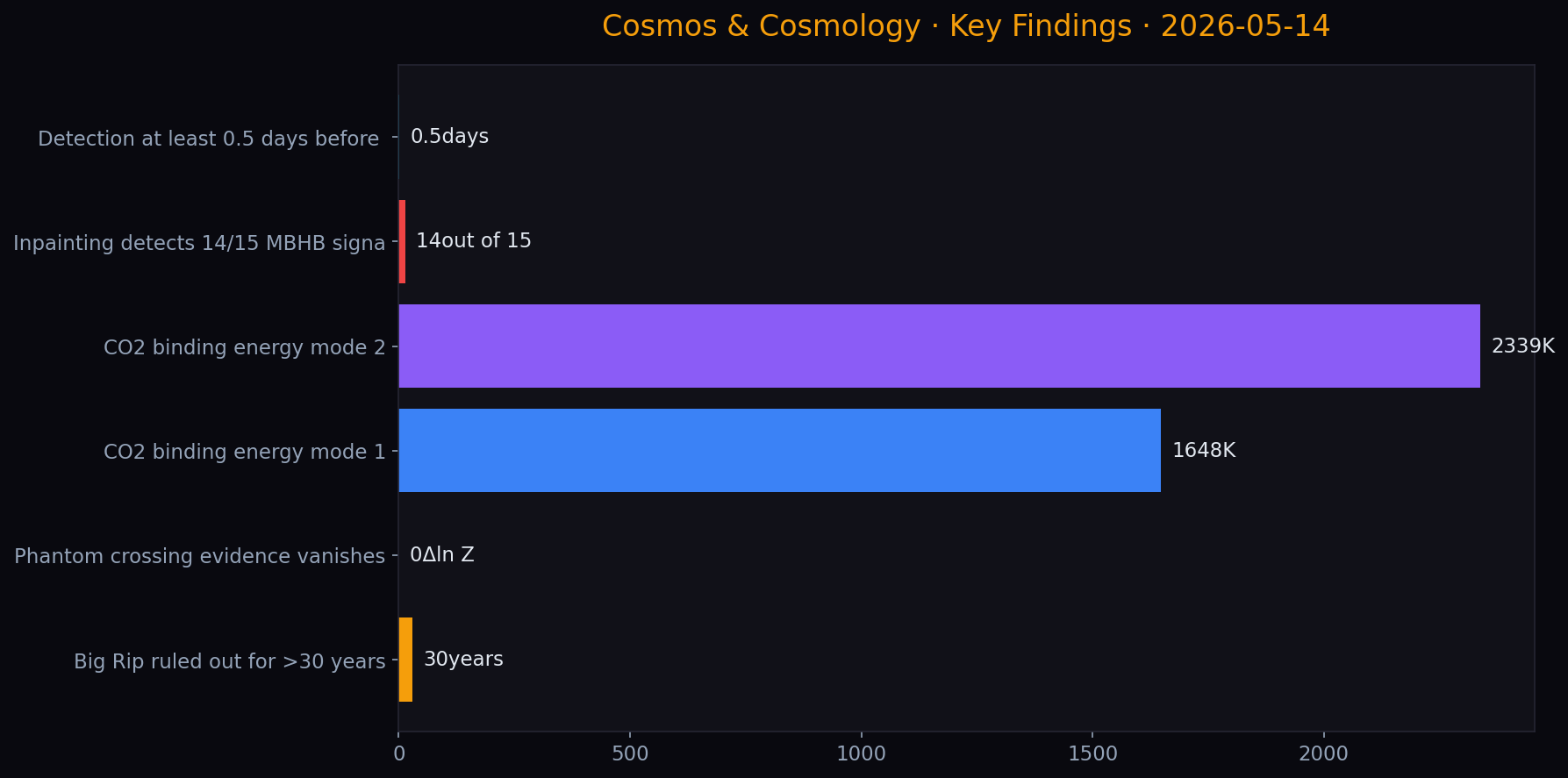
A team of researchers has now closed this loophole. Using solar system orbital dynamics, they derive a model-independent lower bound of 30 years on any Big Rip singularity. The key insight is elegant: a phantom dark energy field that would drive a Big Rip must produce a local dark energy density and time variation detectable through planetary orbital precessions. By analyzing the Earth-Moon system and Mars ranging data, they place the tightest constraints ever on such scenarios. The result is both reassuring and methodologically significant—it provides the first local, model-independent bound on cosmic doomsday, and establishes solar system dynamics as the most sensitive probe for detecting or ruling out imminent singularities. Cosmological observations, it turns out, are effectively blind to changes on sub-Hubble timescales.
The Phantom Menace Fades

If the Big Rip is off the table for at least three decades, what about the phantom dark energy that would drive it? A separate analysis today delivers a verdict that will unsettle those who saw evidence for dynamical dark energy in recent DESI data.
The apparent "phantom crossing"—where the dark energy equation of state parameter w(z) crosses below -1—has been a persistent specter in cosmology. When DESI's first-year data was combined with CMB and supernova datasets, the combined analysis showed tantalizing hints of such behavior. But today's paper demonstrates this is a statistical illusion.
Using Bayesian model comparison with nested sampling across multiple datasets, the authors show that the local goodness-of-fit improvements that favor phantom crossing in DESI+CMB+Pantheon+ analyses vanish under proper global Bayesian comparison. The Bayes factors show no preference for dynamical dark energy over ΛCDM (Δln Z < 0), and the apparent phantom crossing is an artifact of fitting noise in under-constrained parameter spaces.
This is a methodological triumph: it's not enough to show that a more complex model fits better—one must penalize for the added complexity. The phantom crossing, it appears, was never there.
A New Window on the Cosmos: Solar System as Dark Energy Detector
The Big Rip constraint and the phantom crossing debunking, taken together, represent something more significant than either finding alone. They signal a maturation of dark energy science—a shift from asking "is dark energy dynamical?" to "how well can we actually measure it?"
The solar system constraint is particularly striking. Until now, constraints on the Big Rip came exclusively from cosmological data—supernovae, BAO, CMB—which are fundamentally limited by the Hubble timescale. Solar system dynamics probe much shorter timescales, and the 30-year bound emerges not from any exotic physics but from the simple requirement that Earth's orbit hasn't changed detectably in the time we've been observing it.
This matters because it's the first time local, not cosmological, measurements have been used to constrain the end of the universe. The methodology is robust: if a Big Rip were imminent, the local dark energy density would be evolving rapidly, which would produce measurable changes in planetary orbits. The absence of such changes yields the constraint.
Meanwhile, the Bayesian analysis that kills phantom crossing does something equally important: it shows that the apparent evidence for dynamical dark energy in recent DESI data was a statistical artifact. When you properly penalize for model complexity—which frequentist goodness-of-fit tests don't do—ΛCDM remains perfectly consistent with all data. The phantom crossing was never there.
The Quiet Revolution in Black Hole Physics
While the Big Rip papers grab headlines, two other results today represent a quiet but profound shift in how we study black holes.
The quantum field theory of black hole perturbations with backreaction (paper VI in the series) extends gauge-invariant perturbation theory to second order for non-symmetric perturbations. This is technically extraordinary: it provides the first explicit calculation of apparent horizon dynamics and quasi-local mass in a fully backreacting QFT on a spherically symmetric black hole background. The effective metric it constructs enables quantum-corrected Penrose diagrams—literally new pictures of spacetime that incorporate Hawking radiation's backreaction.
Meanwhile, the analysis of thin accretion disks around rotating charged black holes in higher-curvature gravity establishes a phenomenological framework for testing quantum gravity effects without requiring a complete theory. The key finding—that the ISCO shifts inward and radiation flux increases with the Gauss-Bonnet-like parameter α—provides a concrete observable signature. If future observations of black hole accretion disks show systematic deviations from Kerr predictions, this framework will be how we interpret them.
What This Means
For dark energy and the fate of the universe: The combination of solar system constraints on the Big Rip and Bayesian rejection of phantom crossing represents a significant shift. The narrative that "dark energy might be dynamical and we could be headed for a Big Rip" has been a staple of cosmology journalism for years. Today's results suggest that narrative is unsupported. The universe appears to be ΛCDM-like even at late times, and even if it's not, we have at least three decades before anything dramatic happens. This is genuinely reassuring for anyone who was losing sleep over the heat death of the universe.
For gravitational wave astronomy: The LISA inpainting result is a practical engineering triumph. LISA will have data gaps—that's inevitable for a space-based interferometer. The demonstration that pre-merger detection of massive black hole binaries remains robust even with three-day gaps, and that the inpainting method works with overlapping signals, means LISA's multi-messenger potential is real. When LISA sees a merger, electromagnetic observatories will have days of warning.
For dark matter detection: The paleo-detector breakthrough—calorimetric readout combined with track length—achieves sensitivity comparable to future liquid noble gas detectors but with an effective exposure orders of magnitude larger. The key is the calorimetric approach: counting stable lattice vacancies per nuclear recoil, which enables per-event species discrimination. This is a fundamentally new detection modality that doesn't require building ever-larger detectors—it uses ancient minerals as detectors that have been accumulating events for billions of years.
For black hole physics: Two papers advance our understanding in complementary ways. The effective higher-curvature Kerr-Newman metric provides a phenomenological framework for testing strong-gravity deviations—a "plug-and-play" model for observatories like the Event Horizon Telescope. Meanwhile, the QFT backreaction paper (Paper VI) provides the first explicit gauge-invariant calculation of apparent horizon dynamics at second order, enabling quantum-corrected Penrose diagrams. Together, they show that black hole physics is moving from theory to testable predictions.
The Big Picture: What Today's Papers Tell Us
The common thread across today's diverse results is a shift toward model-independent, data-driven constraints. The Big Rip paper uses solar system dynamics rather than cosmological data. The phantom crossing paper uses Bayesian model comparison rather than goodness-of-fit tests. The black hole perturbation theory paper uses gauge-invariant methods. The PSF deconvolution paper uses a novel constraint rather than relying on training data.
This is a field that has learned the hard way that model dependence can mislead. The apparent evidence for phantom crossing from DESI data? It vanishes under proper Bayesian comparison. The supposed Big Rip threat? Ruled out for 30 years by planetary orbits. The field is growing up—and its conclusions are becoming more robust.
Key Takeaways for the Research Community
The solar system is now a dark energy observatory. Solar system dynamics provide the tightest constraints on phantom dark energy, surpassing cosmological surveys for local measurements. The key advance is model-independence—no assumptions about the form of the dark energy equation of state.
The Bayesian revolution in cosmology is real. The phantom crossing evidence vanishes under Δln Z model comparison. This is a methodological victory: local goodness-of-fit is insufficient; global Bayesian evidence is required.
LISA's pre-merger detection problem is solved. The inpainting technique handles data gaps and overlapping signals, enabling electromagnetic follow-up. This is crucial for multi-messenger astronomy.
The standard model of cosmology remains robust. Despite claims of a crisis, ΛCDM remains consistent across multiple independent tests, and claims of its demise are, at minimum, premature.
Open Questions
The field advances, but key questions remain:
- What is the true nature of dark energy? The solar system constraints rule out an imminent Big Rip but say nothing about the
Published by KHI Research · 2026-05-14 · AI Methodology
Discussion